| Home |  |
| | |
About the site | |
| | |
Memos | |
| | |
Contact | |
Alvarez Physics Memos
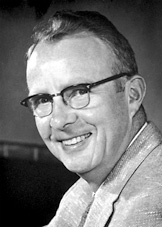 |
Luis W. Alvarez was a Nobel Laureate
Physicist with a long career as a creative and innovative
scientist. Known as Luie to everyone, among his many productive
years was a period at the Lawrence Berkeley Laboratory during which
he developed the high-energy particle detector known as the
hydrogen bubble chamber and pioneered the use of digital computer
technology to analyze the photographs that it produced.
Indeed, his citation for the Nobel Prize of 1968 says: Using many of these same computer-based data analysis techniques Alvarez also organized and directed a large and fruitful effort in detecting and investigation of both cosmic rays and electromagnetic radiation at high altitudes. |
|
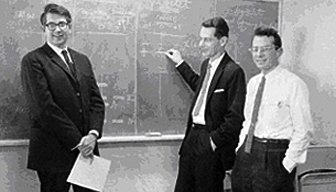 Alvarez led a group of other physicists, graduate students, engineers,
and technicians known originally as the Alvarez Group and later as
Group A. The intellectual work of this group was recorded in three
levels. The first and highest level was the publication of articles in
the physics journals, primarily Physical Review and Physical Review
Letters. The second and less formal level was in printed reports known
as University of California Radiation Laboratory reports, or UCRL's.
These were printed and distributed by the Lawrence Berkeley Lab (known
then as the Lawrence Radiation Laboratory). Among the UCRL's were the
theses of the scores of students who got their Ph.D.s in the Alvarez
Group. The third and lowest level of formality was what came to be
known as Alvarez Group Memos, which were the working papers of the
group. They were written by almost anyone — physicists,
programmers, engineers, technicians — often handwritten
particularly because the symbols were difficult to type, though many
were more formally typed. They cover a wide variety of subjects and
provide a fascinating look at the working level of science during this
two-decade burst of creativity. Though the memos were informal in the
sense of presentation, they had an extremely rigorous system of review
as they were read and digested by all of the other group members who
might be interested in the subject, and who were definitely not shy in
providing critiques of the work. They were a particularly good tool in
the training of graduate students — both an opportunity for
original scientific writing and a requirement to defend the work
against the queries and comments of these knowledgeable readers.
Alvarez led a group of other physicists, graduate students, engineers,
and technicians known originally as the Alvarez Group and later as
Group A. The intellectual work of this group was recorded in three
levels. The first and highest level was the publication of articles in
the physics journals, primarily Physical Review and Physical Review
Letters. The second and less formal level was in printed reports known
as University of California Radiation Laboratory reports, or UCRL's.
These were printed and distributed by the Lawrence Berkeley Lab (known
then as the Lawrence Radiation Laboratory). Among the UCRL's were the
theses of the scores of students who got their Ph.D.s in the Alvarez
Group. The third and lowest level of formality was what came to be
known as Alvarez Group Memos, which were the working papers of the
group. They were written by almost anyone — physicists,
programmers, engineers, technicians — often handwritten
particularly because the symbols were difficult to type, though many
were more formally typed. They cover a wide variety of subjects and
provide a fascinating look at the working level of science during this
two-decade burst of creativity. Though the memos were informal in the
sense of presentation, they had an extremely rigorous system of review
as they were read and digested by all of the other group members who
might be interested in the subject, and who were definitely not shy in
providing critiques of the work. They were a particularly good tool in
the training of graduate students — both an opportunity for
original scientific writing and a requirement to defend the work
against the queries and comments of these knowledgeable readers. 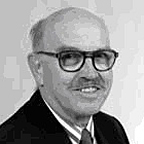 Many of the memos were highly pedagogical in content, usually the
result of a graduate student or a physicist working their way through
a problem, and then writing it up for readers to use as a guide.
Popular topics were relativistic kinematics of two-body and multi-body
interactions, angular-momentum expansions into partial waves, and the
design and layout of particle beams. Even topics perhaps considered
elementary, such as the calculation of cross sections become quite
complicated when you are doing it "for real" and not just for
a homework problem. Janos Kirz's long Physics Memo 640 on how to handle
the details of cross-section calculations was probably much appreciated
by later students.
Many of the memos were highly pedagogical in content, usually the
result of a graduate student or a physicist working their way through
a problem, and then writing it up for readers to use as a guide.
Popular topics were relativistic kinematics of two-body and multi-body
interactions, angular-momentum expansions into partial waves, and the
design and layout of particle beams. Even topics perhaps considered
elementary, such as the calculation of cross sections become quite
complicated when you are doing it "for real" and not just for
a homework problem. Janos Kirz's long Physics Memo 640 on how to handle
the details of cross-section calculations was probably much appreciated
by later students.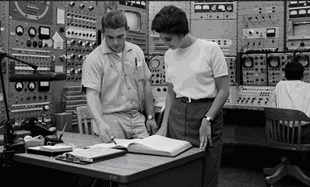 Memos were organized, and usually typed by Luie's long-time secretary
Ann McLellan, who assigned numbers and kept the original copies.
Distribution to various interested parties was left up to the author,
but any copy of any memo was available from Ann. Physics is a
competitive business, and some memos were marked Not For Distribution
to protect ideas or concepts, but in practice most of the documents
were widely distributed both by visiting scientists and simply by
ignoring the NFD legends. There were, of course, many memos of interest
only to group members because of their content, often the detailed nuts
and bolts of the complex business of actually doing high energy
physics.
Memos were organized, and usually typed by Luie's long-time secretary
Ann McLellan, who assigned numbers and kept the original copies.
Distribution to various interested parties was left up to the author,
but any copy of any memo was available from Ann. Physics is a
competitive business, and some memos were marked Not For Distribution
to protect ideas or concepts, but in practice most of the documents
were widely distributed both by visiting scientists and simply by
ignoring the NFD legends. There were, of course, many memos of interest
only to group members because of their content, often the detailed nuts
and bolts of the complex business of actually doing high energy
physics.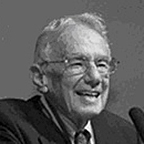 Over the years several other sets of related and supporting memos
were created, and we have also preserved their images on this site.
Engineering Memos, Programming Memos, and HAPPE Memos are included
here.
Over the years several other sets of related and supporting memos
were created, and we have also preserved their images on this site.
Engineering Memos, Programming Memos, and HAPPE Memos are included
here.The Engineering Memos are particularly interesting because they were done very early during the development of the small 10-inch and 15-inch bubble chambers, and they also document some of the earliest efforts in automating the data analysis. As the very first hurdles were encountered in using the bubble chambers, they were documented along with their solutions. These include the first memo on a kinematic fitting computer program, by Lynn Stevenson, and the first Scanners' Instructions, by Art Rosenfeld. These Engineering Memos are precursors of the Physics Memos and were replaced by the later series.
Programming Memos were written by anyone who had an interest in documenting and explaining their computer work, and tend to parallel the Physics Memos. In addition to the physicists, graduate students, and technicians who were using computers to solve data analysis and engineering problems, the Alvarez Group had a staff of professional programmers who tended to concentrate on larger and broader programs for the benefit of all, as opposed to the scientist's more narrow focus on particular experiments and the details of certain data sets. With the development of compact mini-computers the group pioneered using them to control dedicated pieces of hardware, and some of the memos in this collection are pointed toward describing these developments.
In 1964 Alvarez proposed what became know as the High Altitude Particle Physics Experiment, or HAPPE, originally conceived as a large superconducting magnet carried to high altitude by a balloon in order to study extremely high-energy particle interactions (see Physics Memo 503). In time the focus of the experiment changed more toward the study of cosmology and the role of both particles and radiation in the early universe. This work was an early precursor of the satellite-born experiments on the background radiation, which resulted in the award of the 2006 Nobel Prize; shared by George Smoot and John Mather. Here we have included the set of 338 memos which cover through early 1977.
 Nor were all of the memos necessarily about particle physics. Robert
Golden, together with Alvarez and Dave Judd of the Theoretical Group,
wrote Physics Memo 502, The Electrostatic Potential of the Earth and
the Moon. After receiving his degree, Golden joined NASA as a
scientific astronaut candidate and had a career in astrophysics. Stan
Flatté wrote Physics Memo 536, Polar Rise and Equatorial Fall of Sea
Level. After completing his graduate work, Stan Flatté became a
Professor of Physics at UC Santa Cruz specializing in global
oceanography. It is interesting to see how the authors changed over
time. The early memos were written in the very first days of bubble
chamber physics. Frank Crawford and Lynn Stevenson were frequent
authors. Later on with the maturity of the 72-inch and 82-inch
bubble chambers, there were contributions by many authors. Late in the
1980's much effort went into the development of the TPC detector
and Philippe Eberhard wrote many of the memos. Lynn Stevenson wrote
Physics Memo 3 and also Physics Memo 965.
Nor were all of the memos necessarily about particle physics. Robert
Golden, together with Alvarez and Dave Judd of the Theoretical Group,
wrote Physics Memo 502, The Electrostatic Potential of the Earth and
the Moon. After receiving his degree, Golden joined NASA as a
scientific astronaut candidate and had a career in astrophysics. Stan
Flatté wrote Physics Memo 536, Polar Rise and Equatorial Fall of Sea
Level. After completing his graduate work, Stan Flatté became a
Professor of Physics at UC Santa Cruz specializing in global
oceanography. It is interesting to see how the authors changed over
time. The early memos were written in the very first days of bubble
chamber physics. Frank Crawford and Lynn Stevenson were frequent
authors. Later on with the maturity of the 72-inch and 82-inch
bubble chambers, there were contributions by many authors. Late in the
1980's much effort went into the development of the TPC detector
and Philippe Eberhard wrote many of the memos. Lynn Stevenson wrote
Physics Memo 3 and also Physics Memo 965.The memos are in PDF format and may be viewed or downloaded in groups of 10 per file.
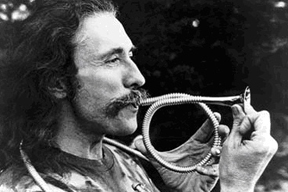
The photos in order, show Luis Alvarez; Sheldon Glashow, George Kalbfleisch, and Arthur Rosenfeld; Lynn Stevenson; a Bevatron Operator and Lina Galtieri; Arthur Rosenfeld; and Frank Crawford.